1982.02.27: February 27, 1982: Headlines: Directors - Ruppe: Figures: Directors: New York Times: After more than a decade of low visibility, the Peace Corps has regained its independent status
Peace Corps Online:
Peace Corps News:
Directors of the Peace Corps:
Peace Corps Director Loret Ruppe Miller (1981 - 1989):
Loret Ruppe Miller:
1982.02.27: February 27, 1982: Headlines: Directors - Ruppe: Figures: Directors: New York Times: After more than a decade of low visibility, the Peace Corps has regained its independent status
After more than a decade of low visibility, the Peace Corps has regained its independent status
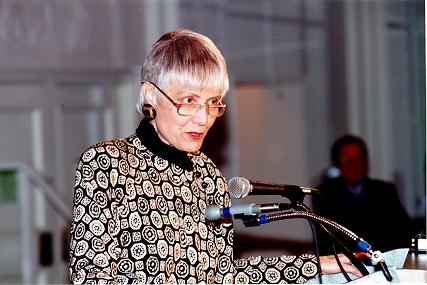
After more than a decade of low visibility, the Peace Corps has regained an independent status it had lost when President Nixon, seeking to downgrade programs inherited from his Democratic predecessors, folded it into an umbrella agency called Action. Last December Congress voted to separate the corps from Action, effective last Monday. More to the point, Loret Miller Ruppe, a moderate Republican chosen by President Reagan to be director of the corps, declared that the agency was alive and well and looking for new challenges and ways to solve them. Idealism of Early Days Independence alone does not insure the recapturing of that very special aura in which the Peace Corps basked in its earlier years, a time when young people, full of idealism and eager to serve, volunteered by the tens of thousands to be of service to the poor of developing nations. Loret Miller Ruppe was Director of the Peace Corps from 1981 to 1989.
After more than a decade of low visibility, the Peace Corps has regained its independent status
PEACE CORPS, REVIVED, SEEKS NEW CHALLENGES
By MARJORIE HUNTER, SPECIAL TO THE NEW YORK TIMES
Published: February 27, 1982
Some months after proposing the Peace Corps in spring 1961, President Kennedy remarked, ''I gave Sarge a lemon and he made lemonade.''
The lemon was the difficult task of translating an idea into reality. The resulting lemonade was Sargent Shriver's carefully constructed framework for a workable Peace Corps, one of the true innovations of the Kennedy Administration.
Now, after more than a decade of low visibility, the Peace Corps has regained an independent status it had lost when President Nixon, seeking to downgrade programs inherited from his Democratic predecessors, folded it into an umbrella agency called Action. Last December Congress voted to separate the corps from Action, effective last Monday.
More to the point, Loret Miller Ruppe, a moderate Republican chosen by President Reagan to be director of the corps, declared that the agency was alive and well and looking for new challenges and ways to solve them. Idealism of Early Days
Independence alone does not insure the recapturing of that very special aura in which the Peace Corps basked in its earlier years, a time when young people, full of idealism and eager to serve, volunteered by the tens of thousands to be of service to the poor of developing nations.
Much of that idealism was shattered by American involvement in the Vietnam War. Being relegated to obscurity as part of Action, without even stationery bearing the words Peace Corps, was another blow to the corps.
The Peace Corps also came under attack from political critics who felt that the presence of volunteers in countries ideologically opposed to the United States was counterproductive. And recent cuts in funds by the Reagan Administration trimmed the ranks of volunteers to a low of about 5,000, from a high of more than 15,000 in 1966.
Despite its newly acquired independence, the Peace Corps faces other problems. Critics charge that Mrs. Ruppe has been under heavy pressure from some within the Reagan Administration not only to politicize her top staff in Washington but also to choose only Republican loyalists as corps directors overseas. New Directors Appointed
Until recently there were a number of vacancies in these country director posts. But a spokesman for the corps says that all but two of the country directorates have now been filled by ''very qualified peoole, many of whom are apolitical.''
Mrs. Ruppe is hoping for greater visibility because she says that Mr. Reagan is totally committed to the corps. President Reagan himself underscored his support of the Peace Corps on Wednesday when he said in a speech to the Organization of American States that he would seek the active participation of the business community in improving the economic conditions in the Caribbean nations, in concert with the Peace Corps.
''The Peace Corps already has 861 volunteers in Caribbean Basin countries,'' the President said, ''and we'll give special emphasis to recruiting volunteers with skills in developing local enterprise.'' Shriver Hails Efforts
Mr. Shriver, now a Washington lawyer, is the first to applaud Mrs. Ruppe's efforts to rejuvenate the Peace Corps that he headed in its first six formative years. ''She's the kind of Republican we tried to recruit into management when we first started out,'' Mr. Shriver commented.
But Mr. Shriver is not convinced that even Mrs. Ruppe can restore the zeal that characterized the Peace Corps in its earlier years. Noting that Mr. Reagan had repeatedly criticized big government and the bureaucracy, he said, ''It's a tragedy that our own Government has been made the enemy.''
There was certainly no government-as-enemy atmosphere at the time the first Peace Corps volunteer, Tom Livingston of Woodale, Ill., reported for duty as an English teacher in a school in Dodowa, Ghana, on Sept. 12, 1961.
Since those early beginnings, more than 80,000 Americans have served tours of duty in the Peace Corps. Advocate of Independence
Much of the credit for the Peace Corps' newly regained independence from Action goes to one of those early volunteers, Tom Scanlon, now an independent Washington consultant on international development. In the last 10 years or so, he has as made repeated apperances before Congressional committees, urging that the Peace Corps be removed from Action so that it could once again be the effective agency he had once known.
As a young volunteer, just shortly out of Notre Dame, Mr. Scanlon became something of a model for Peace Corpsmen of those early years when Kennedy, speaking to a group of Government interns in the summer of 1962, remarked:
''Recently, I heard a story of a young Peace Corpsman named Tom Scanlon who is working in Chile. He works in a village about 40 miles from an Indian village which prides itself on being Communist. The village is up a long, winding road which Scanlon has gone on many occasions to see the chief. Each time, the chief avoided seeing him.''
The President then continued telling this story: Finally, the chief agreed to see the young Peace Corpsman, who asked what he would have to do to help. The chief replied that the snows would come in a few weeks and the volunteer would have to park his jeep 20 miles away and walk.
''The Communists are willing to do that,'' the chief told the young volunteer. ''Are you?'' A few days later, a friend saw Mr. Scanlon and asked what he was doing. ''I'm waiting for the snow,'' the Peace Corpsman replied.
Links to Related Topics (Tags):
Peace Corps Annual Report: 1982; Loret Ruppe Miller; Figures; Directors
When this story was posted in August 2007, this was on the front page of PCOL:





Peace Corps Online The Independent News Forum serving Returned Peace Corps Volunteers
 | Senator Dodd's Peace Corps Hearings
Read PCOL's executive summary of Senator Chris Dodd's hearings on July 25 on the Peace Corps Volunteer Empowerment Act and why Peace Corps Director Ron Tschetter does not believe the bill would contribute to an improved Peace Corps while four other RPCV witnesses do. Highlights of the hearings included Dodd's questioning of Tschetter on political meetings at Peace Corps Headquarters and the Inspector General's testimony on the re-opening of the Walter Poirier III investigation. |
 | Paul Theroux: Peace Corps Writer
Paul Theroux began by writing about the life he knew in Africa as a Peace Corps Volunteer. His first first three novels are set in Africa and two of his later novels recast his Peace Corps tour as fiction. Read about how Theroux involved himself with rebel politicians, was expelled from Malawi, and how the Peace Corps tried to ruin him financially in John Coyne's analysis and appreciation of one of the greatest American writers of his generation (who also happens to be an RPCV). |
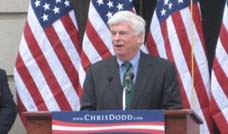 | Dodd issues call for National Service
Standing on the steps of the Nashua City Hall where JFK kicked off his campaign in 1960, Presidential Candidate Chris Dodd issued a call for National Service. "Like thousands of others, I heard President Kennedy's words and a short time later joined the Peace Corps." Dodd said his goal is to see 40 million people volunteering in some form or another by 2020. "We have an appetite for service. We like to be asked to roll up our sleeves and make a contribution," he said. "We haven't been asked in a long time." |
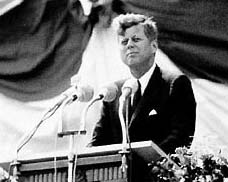 | Public diplomacy rests on sound public policy
When President Kennedy spoke of "a long twilight struggle," and challenged the country to "ask not," he signaled that the Cold War was the challenge and framework defining US foreign policy. The current challenge is not a struggle against a totalitarian foe. It is not a battle against an enemy called "Islamofascism." From these false assumptions flow false choices, including the false choice between law enforcement and war. Instead, law enforcement and military force both must be essential instruments, along with diplomacy, including public diplomacy. But public diplomacy rests on policy, and to begin with, the policy must be sound. Read more. |
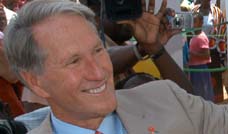 | Ambassador revokes clearance for PC Director
A post made on PCOL from volunteers in Tanzania alleges that Ambassador Retzer has acted improperly in revoking the country clearance of Country Director Christine Djondo. A statement from Peace Corps' Press Office says that the Peace Corps strongly disagrees with the ambassador’s decision. On June 8 the White House announced that Retzer is being replaced as Ambassador. Latest: Senator Dodd has placed a hold on Mark Green's nomination to be Ambassador to Tanzania. |
 | Peace Corps Funnies
A PCV writing home? Our editor hard at work? Take a look at our Peace Corps Funnies and Peace Corps Cartoons and see why Peace Corps Volunteers say that sometimes a touch of levity can be one of the best ways of dealing with frustrations in the field. Read what RPCVs say about the lighter side of life in the Peace Corps and see why irreverent observations can often contain more than a grain of truth. We'll supply the photos. You supply the captions. |
 | PCOL serves half million
PCOL's readership for April exceeded 525,000 visitors - a 50% increase over last year. This year also saw the advent of a new web site: Peace Corps News that together with the Peace Corps Library and History of the Peace Corps serve 17,000 RPCVs, Staff, and Friends of the Peace Corps every day. Thanks for making PCOL your source of news for the Peace Corps community. Read more. |
 | Suspect confesses in murder of PCV
Search parties in the Philippines discovered the body of Peace Corps Volunteer Julia Campbell near Barangay Batad, Banaue town on April 17. Director Tschetter expressed his sorrow at learning the news. “Julia was a proud member of the Peace Corps family, and she contributed greatly to the lives of Filipino citizens in Donsol, Sorsogon, where she served,” he said. Latest: Suspect Juan Duntugan admits to killing Campbell. Leave your thoughts and condolences . |
 | Warren Wiggins: Architect of the Peace Corps
Warren Wiggins, who died at 84 on April 13, became one of the architects of the Peace Corps in 1961 when his paper, "A Towering Task," landed in the lap of Sargent Shriver, just as Shriver was trying to figure out how to turn the Peace Corps into a working federal department. Shriver was electrified by the treatise, which urged the agency to act boldly. Read Mr. Wiggins' obituary and biography, take an opportunity to read the original document that shaped the Peace Corps' mission, and read John Coyne's special issue commemorating "A Towering Task." |
 | He served with honor
One year ago, Staff Sgt. Robert J. Paul (RPCV Kenya) carried on an ongoing dialog on this website on the military and the peace corps and his role as a member of a Civil Affairs Team in Iraq and Afghanistan. We have just received a report that Sargeant Paul has been killed by a car bomb in Kabul. Words cannot express our feeling of loss for this tremendous injury to the entire RPCV community. Most of us didn't know him personally but we knew him from his words. Our thoughts go out to his family and friends. He was one of ours and he served with honor. |
Read the stories and leave your comments.

Some postings on Peace Corps Online are provided to the individual members of this group without permission of the copyright owner for the non-profit purposes of criticism, comment, education, scholarship, and research under the "Fair Use" provisions of U.S. Government copyright laws and they may not be distributed further without permission of the copyright owner. Peace Corps Online does not vouch for the accuracy of the content of the postings, which is the sole responsibility of the copyright holder.
Story Source: New York Times
This story has been posted in the following forums: : Headlines; Directors - Ruppe; Figures; Directors
PCOL38828
82