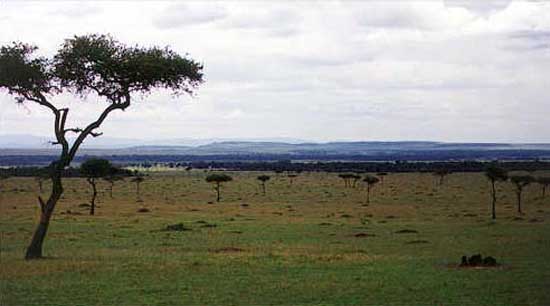
RPCV Melanie Thompson provides students with glimpse of Kenya
Students glimpse Kenya Peace Corps volunteer visits China classroom
By COLIN HICKEY, Staff Writer
Copyright © 2003 Blethen Maine Newspapers Inc.
CHINA , MAINE— Melanie Thompson has eaten termites and survived without electricity and running water for two years.
Staff photo / DAVID LEAMING Peace Corps volunteer Melanie Thompson helps China Middle School eighth-grade student Mike Stango with a Kenyan garment and headgear during a presentation Tuesday. click to enlarge
Harsh existence?
The answer, Thompson explained Tuesday to Lisa Ericson's eighth grade class at China Middle School, depends on where you live.
If you live in Kenya, an African country that Thompson called home during her time as a Peace Corps volunteer, then termites for dinner and a house without plumbing and power is not harsh but normal.
"If you are rich enough to have an outhouse in Kenya, you put it right in the front yard," she said.
Thompson, who wore a colorful Kenyon skirt and, in the Kenyon tradition, balanced a wicker basket on her head, ended her service in the Peace Corps nearly 25 years ago.
But she still holds true to one of the tenets of the organization, the one that calls for members to share their Peace Corps' experiences with those back home, with fellow Americans.
That is what brought Thompson, a South China resident, to spend the day at China Middle School, describing the life she led for two years as a young woman just out of college.
Her goal was to give students a better understanding of another culture and a greater appreciation of the wealth and abundant opportunities in the United States and other highly developed countries.
She asked them to consider how their morning would have been if they had no bathroom in their house, no appliances to cook their food, no water to draw from the tap.
Thompson explained how she functioned in such primitive conditions during her two years in a small mountain village in Kenya.
To get water for drinking and washing, Thompson said, she had to rely on Mother Nature, collecting rain drops in a big tin can during the wet season.
When the dry months arrived, the river was her source of water, although a less than ideal one. Thompson said waterways in Kenya tend to be filled with parasites and bacteria because of the virtual lack of sanitary systems.
To avoid sickness, boiling water is critical, she said. But even with taking such precautions, Thompson said diarrhea is common and ranks as the leading cause of death among Kenyans.
Ericson said students in the United States need to hear what life is like in Kenya and other underdeveloped countries.
Too often, she said, her students complain about a computer not working or some other minor inconvenience.
Those same students learn how trivial such problems are when compared to the rigors that a child in Kenya faces on a daily basis.
Thompson ended her presentation by dividing students into three groups, representing the world's poor, moderate income and wealthy.
She gave a bag of M&M candies to each group, but the poor students, by far the largest contingent, received the fewest M&M candies.
The rich students, by far the fewest in number, received the largest candy supply.
It was a telling way to show how the world's resources are not distributed evenly, another way to give students a new perspective on the lives they lead.
Colin Hickey — 861-9205
chickey@centralmaine.com