My American Home
| By Admin1 (admin) (pool-151-196-123-27.balt.east.verizon.net - 151.196.123.27) on Wednesday, March 23, 2005 - 3:49 pm: Edit Post |
I wonder sometimes what I was thinking, coming here.
Usually this happens late at night when for one reason or another I can't sleep.
Sometimes it is too hot for sleep, and so I lie under my mosquito net and let the sweat trickle off me, waiting for sheer exhaustion to win out.
Sometimes my day is so across-the-board awful that I can do nothing but think about it, worry it like a loose tooth until I drop off into the bizarre dreams that my malaria prophylaxis brings.
I have been a Peace Corps volunteer in West Africa for about 10 months now, and even after all this time, all those sleepless nights, I still can't really explain why I came, nor do I have any clear idea of why I remain.
I have, however, had ample time to reflect on my American life, the good and the bad, the lovely and the very, very ugly. This is a job, an experience, which lends itself to introspection, to self-doubt, to late-night examinations of the day's choices.
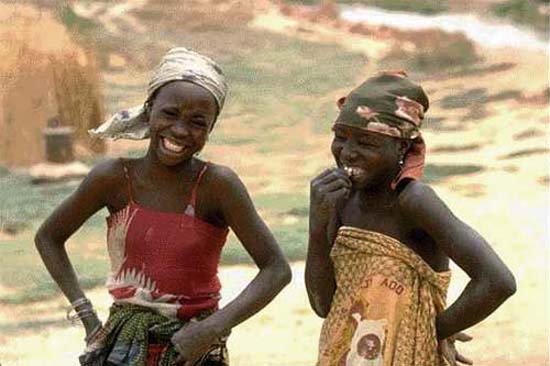
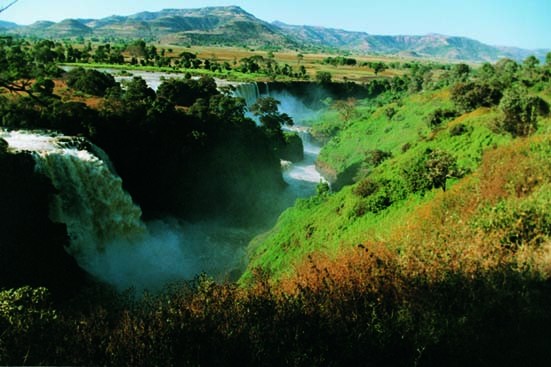
I serve in Togo, a thin sliver of a country wedged between Benin and Ghana.
Before coming here, not only could I not point it out on a map,
I couldn't even tell you what continent it was on.
Now that it is my home, it has become the center of my own private universe.
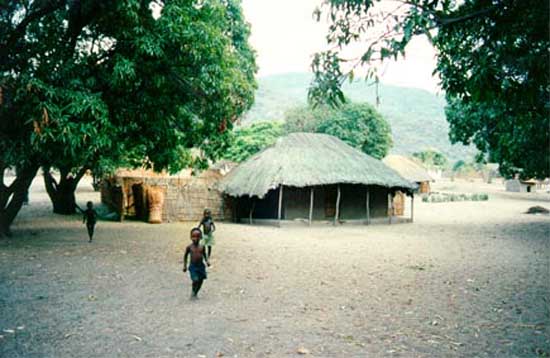
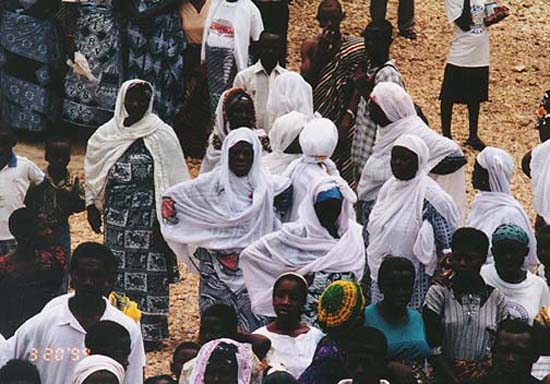
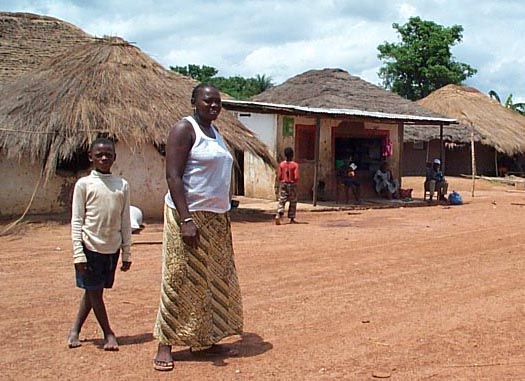
Tokpli, my village, is fairly small, with only about 2,000 to 3,000 people (depending on whom you ask).
It is situated just on the Benin border, where the two countries are separated by the narrow Mono River, a turbid, filthy body of water from which most of the villagers drink and in which they bathe.
Like most volunteers, I live without electricity and running water, luxuries I do not miss nearly as much as I thought I would.
I do miss many things, some with an intensity that knots my stomach.
I miss the confidence I once had, in myself and in my mission. I miss the smell of brewing coffee and frying bacon.
But really what I miss most of all is my anonymity. I am the only white person in my village, and nearly every movement and action of mine is scrutinized.
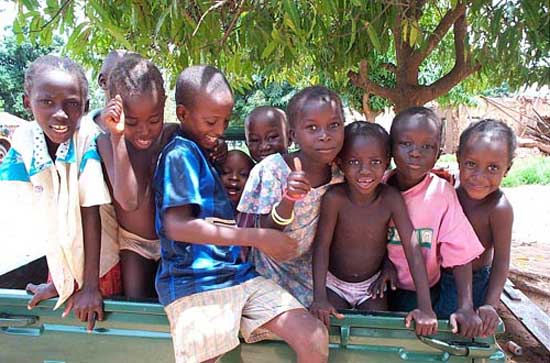
Groups of children gather just to watch me buy tomatoes. I chafe under their gaze, the pressure building until, inevitably, I explode, usually at someone who does not deserve it.
I have never known such rage.
But I don't want to mislead.
All is not misery and despair.
There are moments in the village that are nothing short of sublime, moments that feel like spiritual epiphany.
Even with all the problems, all the frustrations, all the times I am sick to death of the poverty and the unhappiness, I love my village.
How else could it break my heart so consistently?
I have never known such hospitality.
Unlike a growing number of people, the Togolese love America. For the people of Tokpli, my home is a shining El Dorado, the same land of dreams and prosperity that has drawn immigrants for centuries.
Many here dream of emigrating, and as a result I am plagued by requests for visas, something I know almost nothing about.
Not all want to go, and not all of those who would go would stay, but almost everyone agrees that here in Togo opportunities are as scarce as the elephants that once roamed the land.
There are days when Togo seems to be a country without hope.
Even for those who don't wish to leave,
America is nothing short of fascinating.
In talks with patients at the dispensary, in conversations around the communal bowl of mashed yams, I am often subjected to an intense and exasperating question-and-answer period.
I am the resident expert on all things American, the final word on a subject that almost never loses its appeal. "Why are American families so small?" (Four or 5 rather than 8 or 11 or 16.) "Why don't you know how to farm?" "Why do you feed your dog so much? Are you going to eat her like the Kabye do up north?"
And, more poignantly, "Why is Africa so poor?" "Why do we suffer more than other places?" "Why is AIDS so prevalent here?"
I stumble through my answers, groping clumsily for the right words in French, a language that is native to none of us, wanting so badly to explain but rarely knowing how.
At night, exhausted but sleepless, I listen to the BBC with one ear and continue to search for answers, any answers.
These midnight agonies rarely rise above navel-gazing. If it seems profound in the pitch black of night, by morning it is about as deep as the puddles that form in my front yard.
I find myself hedging, qualifying. "Well, this is true for some Americans …" and "Well, that depends … "
I wonder sometimes if my friends grow tired of my constant evasions and revisions, if my refusal to give absolutes is more confusing to them than if I had said nothing.
In essence, I am saying clumsily what Whitman said so well: "Do I contradict myself? / Very well, then, I contradict myself; / (I am large—I contain multitudes)."
I am tempted to say simply that America is like that, too.
Like any other nation, it is built upon a motley assortment of oppositions. We champion civil liberties and deny them to those we perceive as enemies.
We celebrate peace while we wage a costly and perhaps unjustifiable war in Iraq.
We value racial and gender equality but do not yet enjoy it. We lament the busyness and complexity of our lives but seem to go out of our way to complicate our schedules.
We fret constantly about our health and appearance but keep getting fatter.
So, really, how can I explain my country, myself?
But I am not satisfied with this response.
I believe it to be true, it should be obvious to anyone, but it isn't enough somehow.
Surely there is something that makes me an American. Truth be told, I still have only the barest of notions, and can state with certainty only what stands in opposition to that which surrounds me.
I cannot offer statistics or studies or expert testimony—I don't have access to those things here. I speak only for myself, from my 23 years of experience as an American. Do with it what you will.
First, foremost, and most evident is our enduring attachment to the Rugged Individual, that paragon of strength and fortitude, he or she of the inventive mind and creative spirit.
The one who isn't afraid to stand alone, who refuses to back down from a fight that is worth the struggle.
Witness the modern-day admiration for Winston Churchill, Martin Luther King Jr., Thomas Edison, every character that John Wayne ever played. (And is that what brought me to Togo?
Some half-baked notion of me against an unjust world?) From this notion of independence springs our deep love of our freedoms, our resentment of any perceived infringements. We tolerate diversity and difference better than most countries, though not as well as we'd like to think.
We do not trust our government, but we do trust in the power of the law to solve our problems (from this, perhaps, comes our tendency to sue just about anyone for any reason).
We trust also in a better tomorrow, and our ability to bring it to the rest of the world.
We are in love with the idea of the happy family, and as a result are somewhat absurdly centered on our children. Our idealism is perhaps unmatched anywhere else in the world.
We worship youth, celebrity, convenience, the almighty dollar, and God, though not necessarily in that order. Accustomed to a fast-paced life, we have little patience.
We want it to happen now, today, this minute, if possible.
We believe in science, in its ability to deliver us from our ills.
We are, for better or worse, firmly convinced of the superiority of our popular culture, but we welcome the best of what other countries have to offer.
We are by no means blind to our faults and mistakes, but remain for the most part certain that the United States is the finest country on earth. Why else would we be so powerful, so emulated, so despised by the kind of people who fly planes into buildings?
Our much-cited arrogance is that of any powerful nation, and though it grieves me to see what horrors we have wrought in the name of security, I still don't think I'd want to live anywhere else.
So, please, take this summary for what it is—a plea for understanding from a somewhat reluctant patriot.
There is much to admire and much to hope for as of yet. As for me, I continue to toss and turn, sleepless, waiting only for daybreak.
When this story was posted in March 2005, this was on the front page of PCOL:Read the stories and leave your comments.
Peace Corps Online The Independent News Forum serving Returned Peace Corps Volunteers
The Peace Corps Library
Peace Corps Online is proud to announce that the Peace Corps Library is now available online. With over 30,000 index entries in over 500 categories, this is the largest collection of Peace Corps related reference material in the world. From Acting to Zucchini, you can use the Main Index to find hundreds of stories about RPCVs who have your same interests, who served in your Country of Service, or who serve in your state.
Crisis Corps arrives in Thailand
After the Tsunami in Southeast Asia last December, Peace Corps issued an appeal for Crisis Corps Volunteers and over 200 RPCVs responded. The first team of 8 Crisis Corps volunteers departed for Thailand on March 18 to join RPCVs who are already supporting relief efforts in Sri Lanka, Indonesia, Thailand, Malaysia, and India with other agencies and NGO's. 19 Mar 2005
March 19, 2005: RPCV Groups in the News
New Jersey RPCVs host exhibit in Maplewood on April 2 20 Mar
Maryland RPCVs eat crab cakes in Annapolis 17 Mar
Illinois RPCVs present "Life on the Big Red Island" 13 Mar
San Diego RPCVs host reception with Gaddi Vasquez on March 6 4 Mar
Western North Carolina's RPCVs sponsor Africa Night on March 6 3 Mar
Connecticut RPCVs held fundraiser on March 5 3 Mar
RPCVs: Post your stories or press releases here for inclusion next week.
RPCVs in Congress ask colleagues to support PC
RPCVs Sam Farr, Chris Shays, Thomas Petri, James Walsh, and Mike Honda have asked their colleagues in Congress to add their names to a letter they have written to the House Foreign Operations Subcommittee, asking for full funding of $345 M for the Peace Corps in 2006. As a follow-on to Peace Corps week, please read the letter and call your Representative in Congress and ask him or her to add their name to the letter.
Add your info now to the RPCV Directory
Call Harris Publishing at 800-414-4608 right away to add your name or make changes to your listing in the newest edition of the NPCA's Directory of Peace Corps Volunteers and Former Staff. Then read our story on how you can get access to the book after it is published. The deadline for inclusion is May 16 so call now.
March 1: National Day of Action
Tuesday, March 1, is the NPCA's National Day of Action. Please call your Senators and ask them to support the President's proposed $27 Million budget increase for the Peace Corps for FY2006 and ask them to oppose the elimination of Perkins loans that benefit Peace Corps volunteers from low-income backgrounds. Follow this link for step-by-step information on how to make your calls. Then take our poll and leave feedback on how the calls went.
Make a call for the Peace Corps
PCOL is a strong supporter of the NPCA's National Day of Action and encourages every RPCV to spend ten minutes on Tuesday, March 1 making a call to your Representatives and ask them to support President Bush's budget proposal of $345 Million to expand the Peace Corps. Take our Poll: Click here to take our poll. We'll send out a reminder and have more details early next week.