Seth Taapken and Stephanie Chatelain-Taapken were married in October 2002, were in Madagascar by February, getting used to the rural life, eating rice three times a day, and dodging leeches and malaria-carrying mosquitos
Couple returns from afar
Scott De Laruelle
The children of world travelers, it probably came as no surprise that Baraboo's Seth Taapken and Stephanie Chatelain found a common bond and a love for globe-trotting. They spent more than two years halfway across the globe in the Peace Corps.
Baraboo High School graduates Seth Taapken (1996) and Stephanie Chatelain-Taapken (1997) married in October 2002 were in Madagascar by February, getting used to the rural life, eating rice three times a day, and dodging leeches and malaria-carrying mosquitos. It wasn't all hardship, though, and after a few difficult months adjusting to their new surroundings, the husband and wife team hit their stride.
The pair returned last week from their journey to the Indian Ocean island, and shared their memories of their life-changing experience as they began settling back into their "American" routines.
Seth's parents lived in the Caribbean for awhile and Stephanie's parents lived in Columbia. Both of them studies abroad while in college Stephanie studied in Switzerland and Seth studied in Costa Rica.
"The travel bug has been around for a long time," said Seth.
Stephanie said the thought of joining the Peace Corps came while the two were living in Santa Fe a couple years ago.
"We talked about it and decided we wanted to go and experience the Third World and learn some cool stuff," Stephanie said.
Seth said the Peace Corps doesn't give people much of a choice where to go, but they both were intrigued with the idea of working in Madagascar, the Indian Ocean island nation roughly the size of California.
"It sounded so exotic," Seth said.
The eighth continent
Stephanie said Madagascar is a country of variety the central part of the island is mountainous, the eastern side has rainforest, and the western side has sand and forests.
"That's the amazing part of that island," Seth said. "Every corner is something completely new."
The wildlife is just as varied, said Seth. The pair encountered a colorful spectrum of plants and animals as they traveled the country.
"The parks and all the wildlife in Madagascar are incredible," Seth said. "A lot of people call it the 'eighth continent' because 80 percent of plants and animals are only found there. They have great variety in the island you can go from rainforest to desert to coral reefs. It's all there."
The weather also took a bit of adjustment for the Wisconsinites.
"They have a little bit of winter from June to August, but the lowest it gets is 50 degrees," Stephanie said. "In summer, it's usually 95 or 100 degrees and humid. Your clothes mold, your shoes and belts it's gross."
Stephanie said it took awhile to adjust to the slower pace of life on the island.
"There's not a lot going on," Stephanie said with a chuckle.
The culture shock took a while to get used to.
"It's overwhelming," Stephanie said. "I had never been to a developing country before, and it was shocking at first, but then fascinating to learn what the people are like and how they live."
When they first arrived, they trained for three months at a rural area with a host family, where they began to learn to speak Malagasy, the native language. Seth said living with a host family was a unique experience.
"Everyone is very small (in Madagascar), so their houses were small and I always felt I was going to break the furniture," he said. "Sitting at dinner, I could barely get my feet under the table."
Stephanie said they were the first Peace Corps people in their village of about 1,000-1,500 people.
"You're in a little village walking through rice paddies to talk to language classes within a day of getting there," Seth said. "The first months there were incredibly challenging and incredibly tiring."
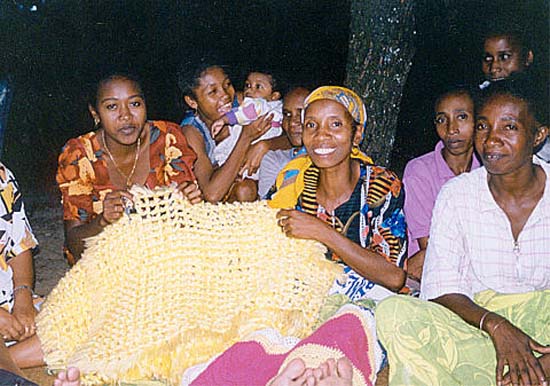
The pair was stationed on the east coast of the island, right below the rainforest, spending most of their time studying the effect of the population on the nearby forest. They had a variety of duties, including meeting with some local dignitaries.
"We would meet with kings and have to bring them a liter of the local rum," Seth said with a laugh. "It was horrible."
Headed south
The couple is planning to move to Madison, where Stephanie will attend nursing school at the University of Wisconsin-Madison in the fall. She said she would recommend the Peace Corps to anyone with an adventurous spirit and a few years to spare.
"If you're looking to go abroad and get new experiences and learn a different language and experience a different culture, the Peace Corps is a good way to go," Stephanie said. "They take good care of you, good support."
Seth said the experience was a bit of an eye-opener to see how people live in less "modernized" parts of the world
"More than half the world does not live like people in the U.S.," Seth said. "It's a good experience to understand what the other half of the world lives like much more simple, more day-to-day, slower-paced."