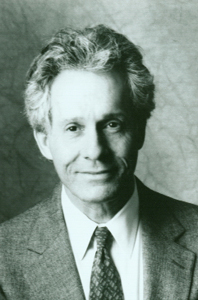
Uganda RPCV David Rudenstine became the first faculty member to be internally promoted to the office of school dean since the Cardozo School of Law opened its doors a quarter century ago
Con Law Professor Named Cardozo Dean
Zack Streit
On Friday, November 16th David Rudenstine became the first faculty member to be internally promoted to the office of school dean since the Cardozo School of Law opened its doors a quarter century ago. The appointment, made by outgoing Yeshiva President Rabbi Dr. Norman Lamm, completed a long search process that began over a year ago.
A member of the Cardozo faculty since 1979, Rudenstine is no stranger to the laborious life of an administrator, having served both as associate dean for academic affairs from 1994 to 1996 and acting dean of the law school for the 1996-1997 academic year, filling the void left by Dr. Frank Macchiarola who left to become President of St. Francis College. Presently, he succeeds Dr. Paul R. Verkuil, who will continue teaching courses at the law school, despite stepping down as dean last year, after four years in that position.
Although questions have surfaced regarding Cardozo's ability to procure a candidate unaffiliated with the law school, Lamm dispelled any such notion. "After an extensive nationwide search, we concluded that David Rudenstine was the most qualified and committed candidate for the job," asserted Lamm. "He is a distinguished legal scholar, one of our most beloved professors, and he has the energy and enthusiasm to lead Cardozo during this new century."
The need for a new dean cropped up after Verkuil informed Vice President of Academic Affairs Dr. Morton Lowengrub of his desire to resign nearly two years ago. Verkuil was then asked to stay on-board for an additional year; the dean agreed to this request before finally stepping down at the close of the previous academic year. In the interim, Dr. Stuart Sterk, H. Bert and Ruth Mack Professor of Real Estate Law at Cardozo, assumed the role of acting dean.
"Stuart was reluctant from the beginning to take on the responsibilities of dean and he did not want to serve any longer than he had to," revealed Rudenstine. "He did a great job and we are indebted to him, but he wanted out. My appointment became effective as soon as it did to relieve him of his duty," he explained, referring to his abrupt, mid-semester appointment.
Lowengrub chaired the search committee, which consisted of four members of the Cardozo Board of Directors, four faculty members, and one student, responsible for deciding the fate of the future dean. The committee took more than a year to select its nominee, who then had to be confirmed by the Cardozo Board of Trustees. "We took the necessary time to find someone who could direct the school with the same success as Paul [Verkuil]," explained Lowengrub.
Some of Verkuil's accomplishments include enlarging the funding base, increasing the faculty stature, raising the mean LSAT score and establishing a chapter of the Order of Coif - a national honors society for graduate students. The latter is considered a major coup for such a young school.
Verkuil's achievement notwithstanding, Cardozo Board Chairman Earle I. Mack expressed optimism in the committee's selection. "David Rudenstine embodies the spirit and shares the philosophy of Cardozo's founding Dean, Monrad Paulsen, who helped create a law school where legal studies are taught in the context of humanities."
Indeed, Rudenstine's vision for the school affirms Mack's assessment. "Part of what I hope to do here at Cardozo is recruit and retain the faculty members committed to legal theory, clinical education and interdisciplinary intellectual activities," claimed Rudenstine. "When you blend these with traditional legal doctrine and classical legal studies, you truly have a unique school."
Rudenstine, the brother of former Harvard University President Neil Rudenstine, authored the critically acclaimed The Day the Presses Stopped: A History of the Pentagon Papers Case, which examines the publishing of the infamous Pentagon papers. The book contends, contrary to dominant perceptions, that the government sued the Times neither fearing political humiliation nor seeking to promote its fight against the media, but because it earnestly believed that the Pentagon Papers promulgated information potentially harmful to national security. He is currently working on Trophies for the Empire: The Tale of the Parthenon Marbles.
This past academic year, Rudenstine was an inaugural fellow at Princeton University's Program in Law and Public Affairs, where he was selected to give the tenth Annual Helen Buchanan Seeger lecture sponsored by the Center for Hellenic Studies. Over the years, he has acted as an arbitrator, mediator, and court-appointed referee for numerous cases.
Currently a teacher of constitutional law, the First Amendment liberties, the federal courts and labor arbitration, Rudenstine earned both his bachelor's and master's degree from Yale University and a juris doctor from New York University, where he was also a fellow in the Arthur Garfield Hays Civil Liberties Program. Previously, he worked as an attorney in the New York City Legal Services Program, director of the citizen's Inquiry on Parole and Criminal Justice, Inc., and acting executive director of the New York Civil Liberties Union.
Rudenstine has worked as a consultant for the Ford Foundation, the Children's Defense Fund, WNET, Fund for the City of New York, and the Correctional Association of New York, among others. He also served as a Peace Corps volunteer in Uganda from 1965 to 1966.
"We have great confidence and great hopes for David [Rudenstine]" related Lowengrub. "We have a lot of trust in what he can do and we believe, without a doubt, that he will take the school to new heights."
Yishai Fleisher, a 2nd-year student at Cardozo echoed Lowengrub's endorsement. "He [Rudentstine] is an excellent teacher with impeccable credentials," Fleisher attested. "He knows the inner workings of Yeshiva, being a homegrown talent?and will be able to head the school towards first-tierdom."
Yisrael Frenkel, another 2nd-year student, who took Rudentstine's Constitutional Law class, also expressed his excitement over the appointment. "Professor Rudenstine is a genius," he enthused. "He can talk to a student instead of over the student's head, which is rare in a law professor, and even rarer in a law school dean."