2007.10.12: October 12, 2007: Headlines: COS - Ethiopia: Expansion: Return to our Country of Service - Ethiopia: VOA: Stephen Johnson remembers first American Peace Corps volunteers in Ethiopia in the 1960s
Peace Corps Online:
Directory:
Ethiopia:
Peace Corps Ethiopia :
Peace Corps Ethiopia: Newest Stories:
2007.10.04: October 4, 2007: Headlines: COS - Ethiopia: Expansion: Peace Corps Press Release: Peace Corps Returns to Ethiopia :
2007.10.12: October 12, 2007: Headlines: COS - Ethiopia: Expansion: Return to our Country of Service - Ethiopia: VOA: Stephen Johnson remembers first American Peace Corps volunteers in Ethiopia in the 1960s
Stephen Johnson remembers first American Peace Corps volunteers in Ethiopia in the 1960s

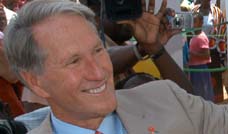
Stephen Johnson was among the first American Peace Corps volunteers in Ethiopia in the 1960s, shortly after the organization was founded by President John F. Kennedy. He had just graduated from college, and was part of a group of teachers sent to help a country where formal education was rare. "In those days there was no attempt to educate the masses," he said. "It was an elitist system in which, what, one percent even went to school. That was a guess, but it was roughly that. And even those who started school in those days, only five percent finished and went on to the university." Johnson recalls that the first wave of 700 Peace Corps teachers made up more than half of all secondary school teachers in Ethiopia. It was the biggest Peace Corps operation in the world at the time. Now, nearly 40 years after his service ended, Johnson is back in Ethiopia as a businessman. He expresses astonishment at the increase in education opportunities over those years. "These days, from when I arrived in 1964, where there were 10 government high schools in the whole country, one figure I've heard is there's over 600 now," he added.
Stephen Johnson remembers first American Peace Corps volunteers in Ethiopia in the 1960s
Peace Corps Returns to Ethiopia After Decade-Long Hiatus
By Peter Heinlein
Addis Ababa
12 October 2007
The U.S. Peace Corps is returning to Ethiopia to resume work that was interrupted by war in 1998. VOA's Peter Heinlein in Addis Ababa reports the Peace Corps program in Ethiopia has changed considerably since it first opened more than 40 years ago, but its mission remains the same.
Stephen Johnson was among the first American Peace Corps volunteers in Ethiopia in the 1960s, shortly after the organization was founded by President John F. Kennedy. He had just graduated from college, and was part of a group of teachers sent to help a country where formal education was rare.
"In those days there was no attempt to educate the masses," he said. "It was an elitist system in which, what, one percent even went to school. That was a guess, but it was roughly that. And even those who started school in those days, only five percent finished and went on to the university."
Johnson recalls that the first wave of 700 Peace Corps teachers made up more than half of all secondary school teachers in Ethiopia. It was the biggest Peace Corps operation in the world at the time.
Now, nearly 40 years after his service ended, Johnson is back in Ethiopia as a businessman. He expresses astonishment at the increase in education opportunities over those years.
"These days, from when I arrived in 1964, where there were 10 government high schools in the whole country, one figure I've heard is there's over 600 now," he added.
That Peace Corps teaching mission worked in Ethiopia until 1977, when it was withdrawn under the disastrous military regime led by Mengistu Haile Mariam. After Mengistu fled to Zimbabwe in the mid-90s, the Peace Corps returned, only to be pulled out three years later when a border war erupted between Ethiopia and Eritrea.
Ironically, the latest return comes just as the simmering border dispute is threatening to boil over again. Stephen Johnson dismisses the talk of another possible war. He argues that the Peace Corps mission should go on anyway.
"The rumors about potential wars, they're always around," he noted. "I think this type of talk doesn't necessarily mean there's anything special going on right now."
The Peace Corps director for Ethiopia, Peter Parr, agrees. He says there are many good reasons why Ethiopia has invited the U.S. volunteer group back a third time.
"I certainly hope that those sorts of tensions that we saw earlier don't continue," he said. "Ethiopia is on a political stabilization track and an economic growth track, so there is a lot of reason for the government and the representatives of government and the representatives of the international community to assist in the stabilization of the region."
Parr notes that this new group of volunteers is unlike previous Peace Corps missions in several ways. For one, the group is small. A total of 43 volunteers, who receive a small salary for their service, arrived this month for language and culture training in preparation for their mission. That is far fewer than the 700 who were here in the 1960s.
For another, the group is not made up of schoolteachers. They will go mostly to rural areas to help people understand the dangers of HIV/AIDS. But Parr says the mission is unchanged.
"The mission for Peace Corps still remains the same as when President Kennedy and Mr. [Sargent] Shriver initiated the Peace Corps," he added. "Peace and friendship is the mission, and then there are the three goals of transfer of skills to other people, and communicating information about other people's values and culture, and taking that back to America and sharing it back home."
Stephen Johnson, from the the initial Peace Corps team in Ethiopia, says it is important for the Peace Corps to re-open here, despite the political turmoil and the war that forced the shut down of the first two missions.
"I think you have to try," he explained. "If there's any place in the world where the Peace Corps can be of value, Ethiopia is that place like that."
Johnson, one of 3,000 Americans who served in Ethiopia during the earlier missions, believes Peace Corps volunteers benefit as much as their hosts. He says, "every country, including the United States, has the need for people to give of themselves to help other people." He says the Peace Corps fulfills that need.
Links to Related Topics (Tags):
Headlines: October, 2007; Peace Corps Ethiopia; Directory of Ethiopia RPCVs; Messages and Announcements for Ethiopia RPCVs; Expansion; Return to our Country of Service - Ethiopia
When this story was posted in October 2007, this was on the front page of PCOL:





Peace Corps Online The Independent News Forum serving Returned Peace Corps Volunteers 
 | Senator Dodd's Peace Corps Hearings
Read PCOL's executive summary of Senator Chris Dodd's hearings on July 25 on the Peace Corps Volunteer Empowerment Act and why Peace Corps Director Ron Tschetter does not believe the bill would contribute to an improved Peace Corps while four other RPCV witnesses do. Highlights of the hearings included Dodd's questioning of Tschetter on political meetings at Peace Corps Headquarters and the Inspector General's testimony on the re-opening of the Walter Poirier III investigation. |
 | What is the greatest threat facing us now?
"People will say it's terrorism. But are there any terrorists in the world who can change the American way of life or our political system? No. Can they knock down a building? Yes. Can they kill somebody? Yes. But can they change us? No. Only we can change ourselves. So what is the great threat we are facing? I would approach this differently, in almost Marshall-like terms. What are the great opportunities out there - ones that we can take advantage of?" Read more. |
 | Paul Theroux: Peace Corps Writer
Paul Theroux began by writing about the life he knew in Africa as a Peace Corps Volunteer. His first first three novels are set in Africa and two of his later novels recast his Peace Corps tour as fiction. Read about how Theroux involved himself with rebel politicians, was expelled from Malawi, and how the Peace Corps tried to ruin him financially in John Coyne's analysis and appreciation of one of the greatest American writers of his generation (who also happens to be an RPCV). |
 | Dodd issues call for National Service
Standing on the steps of the Nashua City Hall where JFK kicked off his campaign in 1960, Presidential Candidate Chris Dodd issued a call for National Service. "Like thousands of others, I heard President Kennedy's words and a short time later joined the Peace Corps." Dodd said his goal is to see 40 million people volunteering in some form or another by 2020. "We have an appetite for service. We like to be asked to roll up our sleeves and make a contribution," he said. "We haven't been asked in a long time." |
 | Public diplomacy rests on sound public policy
When President Kennedy spoke of "a long twilight struggle," and challenged the country to "ask not," he signaled that the Cold War was the challenge and framework defining US foreign policy. The current challenge is not a struggle against a totalitarian foe. It is not a battle against an enemy called "Islamofascism." From these false assumptions flow false choices, including the false choice between law enforcement and war. Instead, law enforcement and military force both must be essential instruments, along with diplomacy, including public diplomacy. But public diplomacy rests on policy, and to begin with, the policy must be sound. Read more. |
 | Ambassador revokes clearance for PC Director
A post made on PCOL from volunteers in Tanzania alleges that Ambassador Retzer has acted improperly in revoking the country clearance of Country Director Christine Djondo. A statement from Peace Corps' Press Office says that the Peace Corps strongly disagrees with the ambassador’s decision. On June 8 the White House announced that Retzer is being replaced as Ambassador. Latest: Senator Dodd has placed a hold on Mark Green's nomination to be Ambassador to Tanzania. |
 | Peace Corps Funnies
A PCV writing home? Our editor hard at work? Take a look at our Peace Corps Funnies and Peace Corps Cartoons and see why Peace Corps Volunteers say that sometimes a touch of levity can be one of the best ways of dealing with frustrations in the field. Read what RPCVs say about the lighter side of life in the Peace Corps and see why irreverent observations can often contain more than a grain of truth. We'll supply the photos. You supply the captions. |
 | PCOL serves half million
PCOL's readership for April exceeded 525,000 visitors - a 50% increase over last year. This year also saw the advent of a new web site: Peace Corps News that together with the Peace Corps Library and History of the Peace Corps serve 17,000 RPCVs, Staff, and Friends of the Peace Corps every day. Thanks for making PCOL your source of news for the Peace Corps community. Read more. |
 | Suspect confesses in murder of PCV
Search parties in the Philippines discovered the body of Peace Corps Volunteer Julia Campbell near Barangay Batad, Banaue town on April 17. Director Tschetter expressed his sorrow at learning the news. “Julia was a proud member of the Peace Corps family, and she contributed greatly to the lives of Filipino citizens in Donsol, Sorsogon, where she served,” he said. Latest: Suspect Juan Duntugan admits to killing Campbell. Leave your thoughts and condolences . |
 | He served with honor
One year ago, Staff Sgt. Robert J. Paul (RPCV Kenya) carried on an ongoing dialog on this website on the military and the peace corps and his role as a member of a Civil Affairs Team in Iraq and Afghanistan. We have just received a report that Sargeant Paul has been killed by a car bomb in Kabul. Words cannot express our feeling of loss for this tremendous injury to the entire RPCV community. Most of us didn't know him personally but we knew him from his words. Our thoughts go out to his family and friends. He was one of ours and he served with honor. |
Read the stories and leave your comments.

Some postings on Peace Corps Online are provided to the individual members of this group without permission of the copyright owner for the non-profit purposes of criticism, comment, education, scholarship, and research under the "Fair Use" provisions of U.S. Government copyright laws and they may not be distributed further without permission of the copyright owner. Peace Corps Online does not vouch for the accuracy of the content of the postings, which is the sole responsibility of the copyright holder.
Story Source: VOA
This story has been posted in the following forums: : Headlines; COS - Ethiopia; Expansion; Return to our Country of Service - Ethiopia
PCOL39383
11