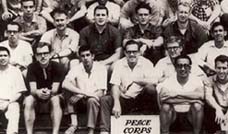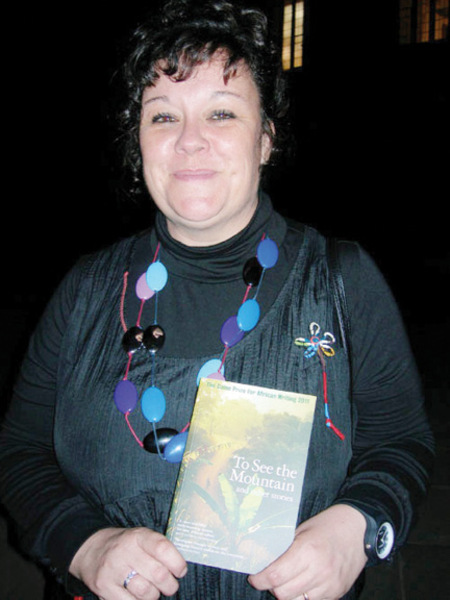
Kubuitsile is a naturalised Motswana. American-born, she came to Botwana with the Peace Corps in 1989, married a local man and the rest, as they say, is African writing. "In America, there were all these boxes that I didn't want to fit inside. Yet there was a part of me that was angry that I couldn't fit into the box," she says of her inner struggles in the United States. "I moved to Botswana as a Science Teacher and met my husband. We decided to stay in Botswana. I was born in America but I don't think I could ever have become a writer if I lived in America my whole life. It was only in Botswana that I found silence."
Lauri Kubuitsile's short story, ‘In the Spirit of McPhineas Lata' was shortlisted for the 2011 Caine Prize, bringing to new height a writing career forged doggedly for the last seven years from Mahalapye, a town north of Gaborone, Botwana's capital
Lauri Kubuitsile: ready for the big time
By Molara Wood
July 18, 2011 10:16AM
Print print Email email Share Share
Lauri Kubuitsile's short story, ‘In the Spirit of McPhineas Lata' was shortlisted for the 2011 Caine Prize, bringing to new height a writing career forged doggedly for the last seven years from Mahalapye, a town north of Gaborone, Botwana's capital.
The story is set in Nokanyana, a village "named after a small river that no one had yet been able to discover," where a legendary lothario, McPhineas Lata has just died, leaving married couples in a tizzy, as hapless husbands plot to win back the attention of unfaithful wives. Kubuitsile had written the piece for ‘The Bed Book of Short Stories', an anthology published in 2010 by Modjaji Books. The premise of the story stemmed from the idea of sex therapists encouraging couples to fantasise in order to keep the love fires burning. "I said to myself: if people are happy, then all is well," a point she tries to prove in the McPhineas story. To achieve this, it was important to get into the male psyche in the narrative. "The men - how would men approach the problem of how to satisfy a woman? They would be deductive, rational," Kubuitsile offers.
The writer was not sure of the story's chances when it was entered for the Caine. "I told [the publisher], this story has no chance. It's a bit of an oddball," she recalls. "Humour can sometimes be undermined - they think literary fiction has to be serious."
The ‘oddball' made the grade nonetheless, selected for the top five from 126 stories entered into this year's award from 17 African countries. "It's a big shock. It's also a big honour. It's most African writers dreams to win the Caine Prize because it's a big deal, although I'm trying not to see it that way," she says.
Being shortlisted is recognition enough in itself, the Motswana writer insists. She takes the time to set out the correct identifiers for people from Botswana, sometimes erroneously referred to outside Southern Africa as ‘Botswanan'. There is no such thing: it is ‘Motswana' for an individual; ‘Batswana' for a collective and ‘Setswana' for the language and culture.
Born in the USA
Kubuitsile is a naturalised Motswana. American-born, she came to Botwana with the Peace Corps in 1989, married a local man and the rest, as they say, is African writing. "In America, there were all these boxes that I didn't want to fit inside. Yet there was a part of me that was angry that I couldn't fit into the box," she says of her inner struggles in the United States. "I moved to Botswana as a Science Teacher and met my husband. We decided to stay in Botswana. I was born in America but I don't think I could ever have become a writer if I lived in America my whole life. It was only in Botswana that I found silence."
Asked what brought about the silence, she pauses to reflect. "There are some things about Botswana... In most instances, I am the only white person. There is no box to be boxed into," and this, for her, has been liberating.
22 years after her relocation, she is something of a prolific author, with 14 published books to her credit. She writes mostly for children and several of her books are on the school syllabus in Botswana, the proceeds of which have eased her transition into full-time writing. However, with bestsellers in the South African publishing industry averaging no more than about 2000 copies, the career of a full-time writer remains a tentative one. "Always, my goal is to try to live on my fiction, but it's not sustainable," Kubuitsile admits.
Popular versus literary fiction
But she soldiers on, navigating the spaces between literary and popular fiction. The author of three detective fiction works, Kubuitsile has also published three romance novels for Sapphire Books, an imprint of South African publisher Kwela. The move into serious writing came seven years ago when Kubuitsile moved with her headmaster husband to Mahalapye. She had a small business but left it in the care of a manager so she could face her writing squarely; and has not troubled herself about the contention between popular and literary fiction. "Except maybe when writing for children, I don't start out thinking this is popular or literary. It's just the story, really. The line is very gray." She writes and lets the reading public decide, but adds that, "It's usually the novels that are literary that get rejected."
Her openness to what may be termed popular fiction has not prevented Kubuitsile garnering accolades for her writing. Winner of the Baobab Prize two years in a row and two Commonwealth Short Story Competition awards among other recognitions, she participated in the El Gouna Writing Residency in Egypt in 2010 and in the 2011 Farafina Trust Workshop.
Coming to Lagos
She flew to Lagos with her fellow Motswana, Wame Molefhe, for the 10-day Farafina Workshop, which ended on July 2. Molefhe and Kubuitsile - writing partners who have collaborated on two television series and other projects - were taught by facilitators led by Chimamanda Ngozi Adichie. "It's been wonderful one thousand times - Chimamanda, Adewale Maja-Pearce, Binyavanga, Tash Aw, Faith Adiele," Kubuitsile says of the experience, as she name-checks the international writers that led the workshop. Of the up and coming Nigerian participants, she says, "It's wonderful. The group, they are so talented. In Botswana, people come to workshops and complain - there's no pen - not so here. They are just here to work."
An epiphany
2011 has been a great year for her, she reports. Apart from the Caine nod and the Farafina experience, it is also the year that brought about what Kubuitsile describes as a much needed epiphany. It came thanks to her reading of ‘The Brief and Wondrous Life of Oscar Wao', the Pulitzer Prize winning novel by Junot Diaz. Kubuitsile explains that when she first started writing, she got many rejections. "I started learning how the publishing industry works," and slanted her writing accordingly, abandoning many novel projects in the process.
But she is set to change her approach, thanks to Junot Diaz. "He understands how a story works but he's going to do things his way," she infers. Reading him taught her that, "You can actually keep the way you want to write, once you learn what they want. With [the Farafina Workshop], I'm finally realising what I really want. Getting these skills has been really good; I had been doing it intuitively."
The author is also working on a collection of short stories to be self-published in e-book. "Right now, we have a lot of opportunities with e-books - you don't need a publisher as long as you have a good editor and cover designer," she declares.
Her writing day follows a disciplined regime. After morning exercises, she heads to her office to deal with emails, blog postings and other matters; she starts writing at 10am and works till around six in the evening, breaking only for lunch. "I don't write on weekends. Night is for reading," she says.
Going back to the Caine shortlist, Kubuitsile reiterates that it isn't all about winning. "The most important thing is what opportunities it will open up for me. I am hoping to get an agent, because I've been working without one and it's tough." Preparing to fly from Lagos to London for the Caine readings and award gala (prize eventually won by Zimbabwean writer, NoViolet Bulawayo), Kubuitsile vows to go back to rework her abandoned novels in line with her new epiphany. "I feel like now, I'm ready."