December 1, 2004: Headlines: COS - Iran: University Administration: AIDS: HIV: Speaking Out: Miami Herald: Donna Shalala says Protect women, families from HIV
Peace Corps Online:
Directory:
Iran:
Special Report: Iran RPCV, Cabinet Member, and University President Donna Shalala:
December 1, 2004: Headlines: COS - Iran: University Administration: AIDS: HIV: Speaking Out: Miami Herald: Donna Shalala says Protect women, families from HIV
Donna Shalala says Protect women, families from HIV
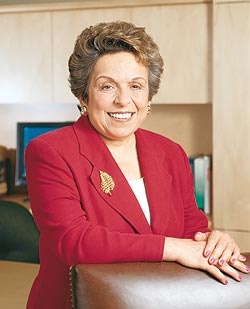
Donna Shalala says Protect women, families from HIV
Protect women, families from HIV
BY KATHLEEN CRAVERO and DONNA E. SHALALA
www.unaids.org
www.miami.edu
Mercy was a teenager when she got married to an older man. Mercy knew about AIDS. But she never took drugs and was faithful to her husband, so she didn't think that AIDS could affect her. Then, during her second pregnancy, her worst nightmare came true -- she was told she was HIV-positive.
She was terrified to tell her husband. She knew he would blame her. Only when her baby grew sick did she explain that both she and the baby had AIDS. Mercy's husband responded just as she feared, with anger and violence. She was thrown out of her house, fired from her job and ostracized from her community.
Mercy's beautiful daughter is now dead and so is her husband. But she's quick to say: ''This isn't just my story -- it's the story of women with AIDS everywhere.''
Today, in sub-Saharan Africa, 60 percent of those with HIV are women and 75 percent of young people infected are girls. In America, AIDS is the leading cause of death among African-American women ages 25-34 -- and Miami has the largest per capita number of women with AIDS nationwide. The fastest growing increases of women with HIV are now found in Eastern Europe and Asia.
In many countries, women are the fabric of family and society. If there's one place in this epidemic where our efforts will yield real results, this is the place. Empowering women and girls to protect themselves and their families from AIDS is key to turning the tide.
What we call the ''ABC'' prevention strategy -- Abstain, Be Faithful, Use Condoms -- is a good start, but not enough. Women are getting infected not only because they lack information, but because they also lack the options to keep themselves safe.
We teach that abstinence until marriage can prevent AIDS, yet we live in a world where girls are often married off as children. We tell women to be faithful, but know their partners often aren't. We tell them to use condoms, but know their partners often won't. We tell them to support their families, but know they often lack tools and opportunities to do so, except through risky behaviors.
In a study in Zambia, only 11 percent of women believed that they had the right to ask their husbands to use a condom -- even if they knew he was unfaithful or HIV-positive. A health survey in Rwanda revealed that nearly 50 percent of men and 67 percent of women agreed that refusing sex or voicing your opinion are acceptable reasons for domestic violence.
If women had the option to choose marriage, rather than have it forced on them; to decide when and with whom they have sex; to negotiate condom use; to live their lives free from violence; to earn incomes adequate to feed their families -- their ability to protect themselves from HIV would be real.
The Global Coalition on Women and AIDS was recently launched by UNAIDS and a wide range of partners to advocate for AIDS strategies that work for women -- something we call ABC plus. Here are some of the pluses:
• Reducing violence against women increases their ability to access services, negotiate safer sex and take advantage of education and employment. Reducing violence against women prevents HIV.
• Protecting the property and inheritance rights of women helps keep their children in school and food on the table without the need to engage in risky behaviors. Protecting women's property rights prevents HIV.
• Ensuring women's access to healthcare keeps them strong and healthy enough to care for their children, attend work and school and keep families intact. Ensuring women's access to healthcare prevents HIV.
• For women who aren't in a position to say No, whose partners won't be faithful or use condoms or who are too beaten up or beaten down to ask, prevention methods that they control are essential. Making microbicides and female condoms a reality for women prevents HIV.
• Keeping girls in school as long as possible will increase their ''right to abstain,'' their knowledge and negotiating skills and make them safer. Keeping girls in school prevents HIV.
• And supporting women with loans to start a small business of their own will increase their economic security and go a long way toward improving the lives of their families. Providing women with a fair shot at job opportunities prevents HIV.
For women and girls like Mercy from Miami to Mombasa, the United Nations, United States and all of us must join forces to help make these strategies a reality -- not just on World AIDS Day, but everyday.
If we value women, and if we are committed to stop AIDS, it's the right thing to do and the smart thing to do.
Kathleen Cravero is the deputy executive director of UNAIDS and leads the Global Coalition on Women and AIDS. Donna E. Shalala is president of the University of Miami.
When this story was posted in November 2004, this was on the front page of PCOL:
 | The Birth of the Peace Corps
UMBC's Shriver Center and the Maryland Returned Volunteers hosted Scott Stossel, biographer of Sargent Shriver, who spoke on the Birth of the Peace Corps. This is the second annual Peace Corps History series - last year's speaker was Peace Corps Director Jack Vaughn. |
 | Charges possible in 1976 PCV slaying
Congressman Norm Dicks has asked the U.S. attorney in Seattle to consider pursuing charges against Dennis Priven, the man accused of killing Peace Corps Volunteer Deborah Gardner on the South Pacific island of Tonga 28 years ago. Background on this story here and here. |
 | Director Gaddi Vasquez: The PCOL Interview
PCOL sits down for an extended interview with Peace Corps Director Gaddi Vasquez. Read the entire interview from start to finish and we promise you will learn something about the Peace Corps you didn't know before.
Plus the debate continues over Safety and Security. |
Read the stories and leave your comments.

Some postings on Peace Corps Online are provided to the individual members of this group without permission of the copyright owner for the non-profit purposes of criticism, comment, education, scholarship, and research under the "Fair Use" provisions of U.S. Government copyright laws and they may not be distributed further without permission of the copyright owner. Peace Corps Online does not vouch for the accuracy of the content of the postings, which is the sole responsibility of the copyright holder.
Story Source: Miami Herald
This story has been posted in the following forums: : Headlines; COS - Iran; University Administration; AIDS; HIV; Speaking Out
PCOL15152
57
.
Please also post or circulate
WAR CRIMES CONFERENCE REPORT
The Conference took place on 19-21 February 2009 at the Institute Of Advanced Legal Studies, London University, in association with SOLON and The Institute of Historical Research. Plenary Talk by Lesley Abdela. List of Speakers in Annexe Two below
Full report at www.research.plymouth.ac.uk/solon/journal/issue%20 3.1/maya%20edited%20final.pdf
For further information on this War Crimes conference and the next one to be held in February 2011, please contact Dr Judith Rowbotham on jrowbotham@gmail.com. Tel. +44 7798 693183
Dr Judith Rowbotham writes: the conference opened with a plenary from Lesley Abdela (see print-out in Annexe One below), a well-known journalist and women’s Human Rights campaigner with war correspondent experience, talking for only half an hour but engaging in a debate with the audience for the remainder of the session which helped to identify many of the themes of the conference - practical agendas and ways of understanding war crimes and war tribunals. Her particular emphasis was on gender as a key factor in reconstructing citizenship, and she talked of the issue of rape, and its wider implications for the legal process.
Conference Focus. A particular focus was given to Bosnia, and to a range of African experiences, particularly in Congo and Rwanda, Sudan/Darfur and Sierra Leone, and to the lesser known events in Cambodia (Silke Studzinsky brought the latest news on the trials just beginning there) and South America.
As well as Peru, the closing plenary delivered by David Sugarman testified to the importance of a global, as well as an historical comprehension in order to understand the impact of war crimes, especially when war crimes tribunals are not an automatic resource.
It was very impressive to hear the range of papers on Bosnia, in particular the panel based around the experiences of the Prosecutor’s Office and the UNDP in Bosnia-Herzegovina. Aided by their Chair, Shireen Fisher (who, until 2008, was an International Judge there), Toby Cadman, Iva Vukusic and Alma Dedic provided absorbing insight into developments.
Identification and Definition of War Crimes: drawing on her experience in the immediate aftermath of conflict in Kosovo, Bosnia, Sierra Leone, Iraq, Afghanistan, Aceh and most recently, Nepal, Lesley Abdela talked of the importance of making the identification and definition of war crimes and their subsequent prosecution more than an admirable concept; and into something which can help in post-conflict reconstruction.
Her particular emphasis was on gender as a key factor in reconstructing citizenship, and she talked of the issue of rape, and its wider implications for the legal process.
That was a theme which regularly re-emerged during the conference, as part of the debate over whether it was possible to identify some international code, and even more importantly, language, of rights which could unite all the participants in war crimes trials. Defining the nature of a war crime, in the cultural spaces of the local/national and the international was a key problematic: Lesley pointed out it was only recently that rape had been identified formally as a war crime, and this identification was hedged around with problems.
The Role of the ICC: There is also the issue of what should be the role of the International Criminal Court: should it involve itself in post-conflict resolution, or was that aspect of war crimes tribunals for other agencies and agendas? Was it possible, or desirable, to draw a line between the work of war crimes tribunals, especially where the ICC was involved, and other agencies (local, national and international)? And what kind of justice was being sought? How could, and indeed should, international jurisprudence trickle down into domestic courts? Should the ICC have a role in this?
How far were such courts located in, and focusing mainly on, the weaker states - economically poorer and less powerful entities or individuals? Erasmus Migyikra, contributing to the first round table with his experiences in Sudan/Darfur, had also raised this issue.
Media reportage underlines that there is a substantial Sudanese perception that the arrest warrant issued by the ICC on 4 March 2009 against the President of Sudan, Omar al-Bashir, by the ICC is part of a neo-colonial conspiracy against the country.
Timing Of War Crimes Tribunals: the theme of the ICC’s role was particularly apparent in the Thursday evening Round Table, when Lesley Abdela again challenged the conference to consider the concept that we were talking about lessons identified, and not yet discussing lessons learned. Talking of war crimes tribunals, she suggested that one thing emerging already from the conference was the issue of their timing, because it bore so importantly on the question ‘What kind of post-conflict justice is acceptable overall?’ Is it important to have elections first, to advance or establish ‘democracy’? Or should there be moves first to deal with war crimes, through international or national (or both) tribunals in that the outcome of tribunals (or Truth and Reconciliation Commissions, alternatively) had the power to affect, profoundly, people’s relationship with a post-conflict constitution and its democratic legitimacy?
An Overall Pattern to War Crimes: the talks delivered by, amongst others, Cissa Wa Numbe and Erasmus Ndemole Migyikra stressed sexual violence – elevated at times to being a tool in a deliberate genocide – is best understood as part of an overall pattern of war crimes. This means that the case studies of events and tribunals in particular regions have a very significant role to play in furthering strategies for dealing with war crimes, whether judicially or socially, as Timothy Waters, Valerie Arnould and Iryna Marchuk demonstrated.
A Second Category of War Crimes And Criminals?: another question raised was whether it is necessary, if a genuine format for international justice is to be achieved, to identify a second category of war crimes and criminals: those who aided or were in some way complicit in the committal of war crimes; those whose aid or compliance was essential to the performance of war crimes without them being actually the perpetrators.
Historical Origins of Attitudes: papers such as that given by Peter Rushton and Gwenda Morgan revealed the historical origins of attitudes which colour a state’s practice when dealing with war crimes. They explored the perceived importance of an observance of legal protocols during the American Revolution/War of Independence, which found real echoes with the strategies adopted by defence lawyers as depicted in the powerfully delivered panel featuring Joe McMillan, Michel Paradis and Melissa Epstein Mills, on prosecutions in Guantanamo Bay, and the prosecution of US servicemen for misconduct during the Iraq war.
The Post-War Italian State: Effie Pedaliu’s paper on the war crimes perpetrated by Italy during World War II argued that the advent of the Cold War and a desire for reconciliation within the post-war Italian state led to very few offenders being prosecuted. Effie Pedaliu further argued that this has led to the fundamental political instability of the modern Italian state, providing an interesting illustrative response to Lesley Abdela’s query whether it was sensible to move to elections without dealing first with the issue of war crimes through some means.
Does The World Give A Damn?: there was also an issue brought up directly by Arzoo Syeddah and Kate Wright, and was implicit in many other talks: ‘How Do We Get Audiences to Give a Damn About the Congo (and for Congo, read any location from Aceh to Peru)?’ ‘What Sort of a Damn Do We Want Them to Give?’
Is there such a thing as compassion fatigue? The Victorians, as Dr Judith Rowbotham pointed out, would not have thought so: why is it identified as a feature of the modern landscape?
Conference Reflections
Despite the horrors that characterise war crimes, from the plenary talk onward, one very positive aspect emerged: the extent to which so many individuals professionally involved in the aftermath of war crime, including investigators, judges, lawyers, researchers, were passionately engaged in, and committed to their work beyond ‘normal’ professional duties, in ways that command respect and admiration.
The range and scope of the commitment demonstrated, in a humbling manner, that original discipline and formal qualifications need be no bar to involvement, witness the role played by Konrad Kweit and his team of historians in bringing Lithuanian Nazis to trial in Australia; and a feature emphasised by Lesley Abdela’s opening talk and David Fraser’s powerful and challenging plenary.
It was not just the speakers: many of the delegates present had tales to tell which demonstrated the same energetic dedication. For instance, Martha Baker and her contribution to defining rape as a war crime.
Pro Bono Work: the paper on representing victims before the ICC given by H Candace Gorman, contextualised by her contribution to discussions through the conference, raised the possibility of interdisciplinary pro bono work being developed to aid war crimes trials – something that SOLON will be very interested to help forward.
A Conclusion
Key Points: Time To Review Existing War Crimes Tribunals. In the concluding Round Table, several key points were held by speakers such as Silke Studzinsky and Jose Pablo Baraybar to have been identified during the conference.
First, it is now time to have a review of the existing war crimes tribunals, including the ICC, and to question the extent to which there is a rule of law which is standard to them. It seems to be agreed by most there that distant courts are not the answer in the majority of cases of trials for war crimes: there is a need for these to be as local as possible, which also raises issues of the compositions of juries in national and international tribunals.
Second, there needs to be a focus on other institutions and what their role in the creation of post-war justice should be – including states and bodies such as the EU, the USA, NATO and the UN.
It was suggested that while there was much discussion from them, there needed to be talks about them in this context.
Urgent Need For A Manual: the creation of a synthesis – a manual – of what makes a successful tribunal is a genuine and urgent need. Whenever a new court is created, it has to create a legal culture for itself – a reference guide of what has worked elsewhere could help to avoid the repetition of old mistakes.
Annexe One
Opening Plenary Session: keynote talk by Lesley Abdela
After the War Is Over…..what of the women?
First let me thank the organisers of this important event. Dr Judith Rowbotham from Nottingham Trent University and her Solon and IALS colleagues have assembled a really impressive group of people, participants and speakers alike, and I look forward very much to these 3 days together.
Dr Rowbotham tells me she invited me to give this opening talk because over the past 10 years I’ve found myself boots on the ground in a set of deeply disturbed countries towards the end of conflict or just after the fighting has ceased.
This is not going to be a list of graphic horror stories, it will be more a practical exposition and will raise some questions, some of which I hope may be explored further during these 3 days.
My first experience of a conflict zone was in the besieged Bihac enclave in Bosnia as a war correspondent for Cosmopolitan Magazine.
A few years after that I arrived in Kosovo 10 weeks after the NATO bombing as Deputy Director for Democratisation for the OSCE.
Then very soon after the rebels were pushed out of Freetown I visited Sierra Leone for the British Council to carry out an assessment on the needs of conflict-affected women.
A couple of months before Saddam was captured I arrived in Iraq.
I then spent a month in Aceh as Gender Advisor to an IOM DDR programme for the reintegration of former combatants.
And last year I spent 6 months in Nepal shortly before the first post-conflict elections where I was Senior Gender Advisor to the UN Agencies.
That’s easily enough about me, but from those experiences come the thoughts I am offering today titled
‘After the war is over ...what of women?’
A topic I frequently ask participants at workshops to discuss is... ‘Why do we consider a man wounded in war a hero, while a woman who has been raped in war an embarrassment?’
Rape has been used as a tactic of terror in many wars.
Rape was a weapon of terror as the Germans marched through Belgium in World War I.
Gang rape was part of the orchestrated riots of Kristallnacht which marked the beginning of Nazi campaigns against the Jews.
It was a humiliation strategy used when the Japanese raped Chinese women in the city of Nanking.
It was a weapon of revenge as the Russian Army marched into Berlin in World War II, and when the Pakistani Army battled Bangladesh. (Bergman 1974: 69)
In those wars, sexual violence did not receive the widespread publicity it has more recently been given in the wars in former Yugoslavia and more recently in the DRC, Sierra Leone, Rwanda and Darfur.
In the Tokyo Trials after the defeat of Japan, acts of sexual violence and rape were not placed at a level that would allow them to stand alone.
At the Nuremburg trials after World War 2 rape in war was defined as a crime against the dignity and honour of a woman – not a crime of violence, not a war-crime and certainly not genocide.
For a long time gender aspects of war crimes were disregarded.
As a result of such omissions, for a long time afterwards no-one knew whether rape in time of conflict could be prosecuted as a separate substantive crime standing on its own merits under international law.
It wasn’t until 1993 when we celebrated 75 years of women getting the vote that I myself realised this situation still continued, after I organised a week of briefing meetings at the House of Commons.
Two of the speakers had just returned from the Balkans. Francoise Hampson, Senior Lecturer in the Department of Law and Centre for Human Rights at Essex University, confirmed that rape camps existed in former Yugoslavia and the women she spoke to said they had been raped on average by 7 different men.
Another of the speakers pointed out that despite the fact Amnesty International had called for the recognition of Rape and Sexual Abuse as torture, it was not yet officially recognised as a war crime so the perpetrators in Bosnia Herzegovina believed they would never be brought to trial for rape at a War Crimes Tribunal.
The Break-Through
In 1993 and 1994 rape and sexual violence were specifically codified for the first time as a recognizable and independent crime within the statutes of the International Criminal Tribunals for the Former Yugoslavia (ICTY) and for Rwanda (ICTR).
These two historic international instruments are now the foundation upon which crimes of rape and sexual violence are punished.
This move forward started quietly within the International Criminal Tribunal for Rwanda in the case of the Prosecutor v. Jean-Paul Akayesu.
The Akayesu decision held that rape or sexual violence could be prosecuted as genocide if the evidence showed it is carried out with the intent to physically or psychologically destroy a group. This landmark case is now the cornerstone for all future genocide and crimes against humanity prosecutions.
There is now solid case law holding that rape and sexual violence are a form of genocide. The ICTY and ICTR cases have also reinforced the legal basis for arguing that rape and sexual violence are individual crimes against humanity, and also constitute violations of the laws and customs of war. This forever altered the landscape of criminal prosecution and affected the scope of consequences that any potential perpetrators must consider.
10 years ago, in late 1998, the ICTY produced equally historic precedents in (excuse my pronunciation) the Celebici, Furudzija, and Delalic cases. These judgments recognized rape as a violation of the Laws and Customs of War and as a basis of torture under the Geneva Conventions.
Furudzija was a watershed because it was the first case to consist exclusively of rape charges.
The next advance in international humanitarian law in this area was to broaden the scope of individual criminal responsibility to leaders and commanders who lend their influence and tacitly encourage crimes against women.
There is now Case law (the Akayesu and Furudgiya cases) that hold that officials and leaders can be directly responsible when they witness acts of sexual violence and rape committed by attackers - even when those attackers are not strictly under their chain of command.
This is particularly important. Today's paramilitary and militia command structures are often covertly organized and not easily defined.
David J. Scheffer, US Ambassador-at-Large for War Crimes Issues said in a talk at Fordham University, New York (October 29 1999) how much he welcomed this advance. He said, “We must combat these intentionally loosely-knit paramilitary and militia by creating laws that are flexible, thus piercing the shields designed to hide the true culprits.”
Summing Up to date:
In summing up where we are to date I’ll revert to my former Political Editor of Cosmopolitan Magazine style and say -
“OK. That’s all great stuff but, how to make it work?”
I’ve learned from my worm’s eye view at ground zero that a major consideration in making War Crimes justice more than an admirable concept into something which can help in post-conflict reconstruction means dealing with a number of practical but easily-overlooked considerations.
Report after report by Amnesty International and other human rights organizations and women's rights advocates show how female rape victims are routinely denied the opportunity to report the rape, ill-treated by forensic medical examiners, interrogated about their sexual history, subjected to abusive questioning by police, prosecutors, defence attorneys and judges and generally blamed for what has happened to them, the women.
I have heard examples of lack of coordination and insensitivity from international agencies and NGOs when they are gathering evidence of sexual violence in war: these include a convoy of white four-wheeler vehicles driving up and parking outside the hut of a rape survivor and/or a series of different humanitarian agencies and human rights groups asking the same person the same ultra-personal questions as part of the information gathering.
A friend of mine, Human Rights Lawyer Margaret Owen, watched proceedings in the War Crimes Tribunal in Arusha. She described how women were mocked and belittled by defence lawyers and most astonishingly by the judiciary.
I recently heard a Judge on the Special Court for Sierra Leone at The Hague tell how her male colleagues were far too readily inclined to disbelieve women who said they had been raped. The male judges demanded firm evidence. By contrast she and other female Judges were inclined to believe women who came to the war crimes court to say they had been raped.
She said she is convinced that “Evidentiary and procedural barriers to successful prosecution of gender based crimes should be removed. Rape happens in cases where the victim is overpowered and there are often no witnesses. Medical evidence often cannot support the rape claim.”
She said, “Judicial hearings on rape should begin by considering the fact that women have more to lose by speaking about the crime, through humiliation and by revisiting the trauma they experienced. The statement of the raped woman should be evidence enough.”
Access to Justice - War Crimes Courts
Witnesses are crucial to the success of any trial but they are frequently the least considered element in practical terms. Yet the protection of witnesses, especially females, in the lead-up to the trial; at the time of the trial and also, crucially, after the trial when they have to return home, is essential. Other basic issues include the matter of the economic costs of being a witness, especially travel, accommodation and living costs. Both men and women but perhaps especially women cite the personal economic costs of being a witness, including travel, accommodation and living costs.
Many women who survive attacks do not want to report the rapes for a variety of reasons. Some women victims of rape express fear they will never be able to marry. Others feel terrified they will be shunned by society. But other very brave women express anger at their attackers and want to testify. That willingness to testify is often tempered by fear that their attackers may still be at large back home, in the conflict region. For those women willing to testify, issues of witness protection and support loom large.
There are still unresolved issues that need to be examined. What about war widows, an agonising feature of so-called modern warfare which heavily targets civilians? International Lawyer Margaret Owen writing to the UN Commission on the Status of Women 2003 noted:
“Women widowed through war and ethnic cleansing, across regions, face rape, sexual mutilation and torture, the deliberate infection of the AIDS virus, sexual slavery and forced pregnancy. The violence meted out to widows during armed conflict, as refugees and IDPs, often continues long into the post-conflict period due to their poverty and vulnerability to economic and sexual exploitation, trafficking and prostitution, and the stigma of having been victims of sexual crimes.”
On the positive side, there is a growing understanding of gender dimensions in identifying and dealing with war crimes, but given the pressures and compromises necessary to make peace quickly, the danger is ever-present that Peace will be sought at almost any cost, including at the cost of Gender Justice. As part of this, there is a real issue with impunity versus accountability.
Questions need to be asked about women's views and needs to ensure these are not bypassed or ignored in the search for quick fixes for short-term stability which may not lead to long-term peace.
A large question
One large question that needs to be asked: where are the instances of political leaders being sentenced for rapes and other acts of sexual violence committed by their followers or Militias under their control? Or a military commander sentenced for rapes/sexual violence committed by his troops?
And should Truth and Reconciliation Commissions as a direct alternative to International Courts be set up, and if they are how they should be composed? Do women's voices get heard properly at such TRCs?
I shall end on the very optimistic note that the development of law on gender-specific war crimes is speeding ahead, further extending the gender dimension of war crimes to genocide. Only last year the entire 15-member UN Security Council unanimously adopted Resolution 1820, which states that ‘rape and other forms of sexual violence can constitute war crimes, crimes against humanity or a constitutive act with respect to genocide’.
It also affirmed the Council’s intention, when establishing and renewing State-specific sanction regimes, to consider imposing ‘targeted and graduated’ measures against warring factions who committed rape and other forms of violence against women and girls. The text made several key requests of the Secretary-General, including that he submit a report on implementation of the resolution by this coming June (2009).
So looking back to my own first glimpse of this important subject, back in 1993, a good amount of progress has been made in those 15 years. Rape is on the books as a war crime. Military commanders can be held responsible for rape by their soldiers.
Now we must enter an era where we work out how to make all the practical implications workable. The Deity rather than the Devil lies in the detail, the nitty-gritty. I shall look forward to any thoughts you may have on any of the above.
Thank you.
Addendum
UNSCR 1820 and UNSCR 1325 are mutually-reinforcing and complementary. 1820 strengthens an area where implementation of 1325 remains particularly weak, namely sexual violence prevention and response. With its strong focus on the condemnation of sexual violence in conflict and post-conflict situations, it provides a Security Council parallel to UN General Assembly Resolution 62/134 (adopted in December 2007) on Eliminating Rape and other forms of sexual violence in all their manifestations, including in conflict and related situations.
UNSCR 1820 includes:
As rape and other forms of sexual violence can constitute a war crime, a crime against humanity or a form of genocide (depending on the elements of the offence), these crimes should be excluded from any amnesty provisions in the context of conflict resolution processes. States need to prosecute the perpetrators and ensure that all victims of sexual violence have equal protection under the law and equal access to justice, thereby ending impunity;
Annexe Two
Speakers included -
Lesley Abdela
Jose Pablo Baraybar, EPAF, Peru
David Fraser, University of Nottingham
Michael Kandiah, Centre for Contemporary British History, London
Konrad Kweit, University of Sydney
Frank McDonough, Liverpool John Moores University
Dr. Cissa Wa Numbe, Director, UN Association of the Dem. Rep. of Congo
David Seymour, University of Lancaster
David Sugarman, University of Lancaster
Juan Santos Vara, University of Salamanca
.
and speakers/delegates from
African Development for Peace Initiative (ADPI); Cambodian Human Rights and Development Association (ADHOC); Copenhagen University; John Jay College of Criminal Justice, CUNY, USA; Department of Defence, Washington, USA; George Mason University, USA; Gibson Dunn LLP, USA; Goethe University, Frankfurt; Herzen State University, St Petersburg; Indiana University, USA; Irish Human Rights, Galway; Perkins Coie Law Firm, USA; Special War Crimes Department, Sarajevo, Bosnia and Herzegovina; UN Development Programme (UNDP)
---fin---